
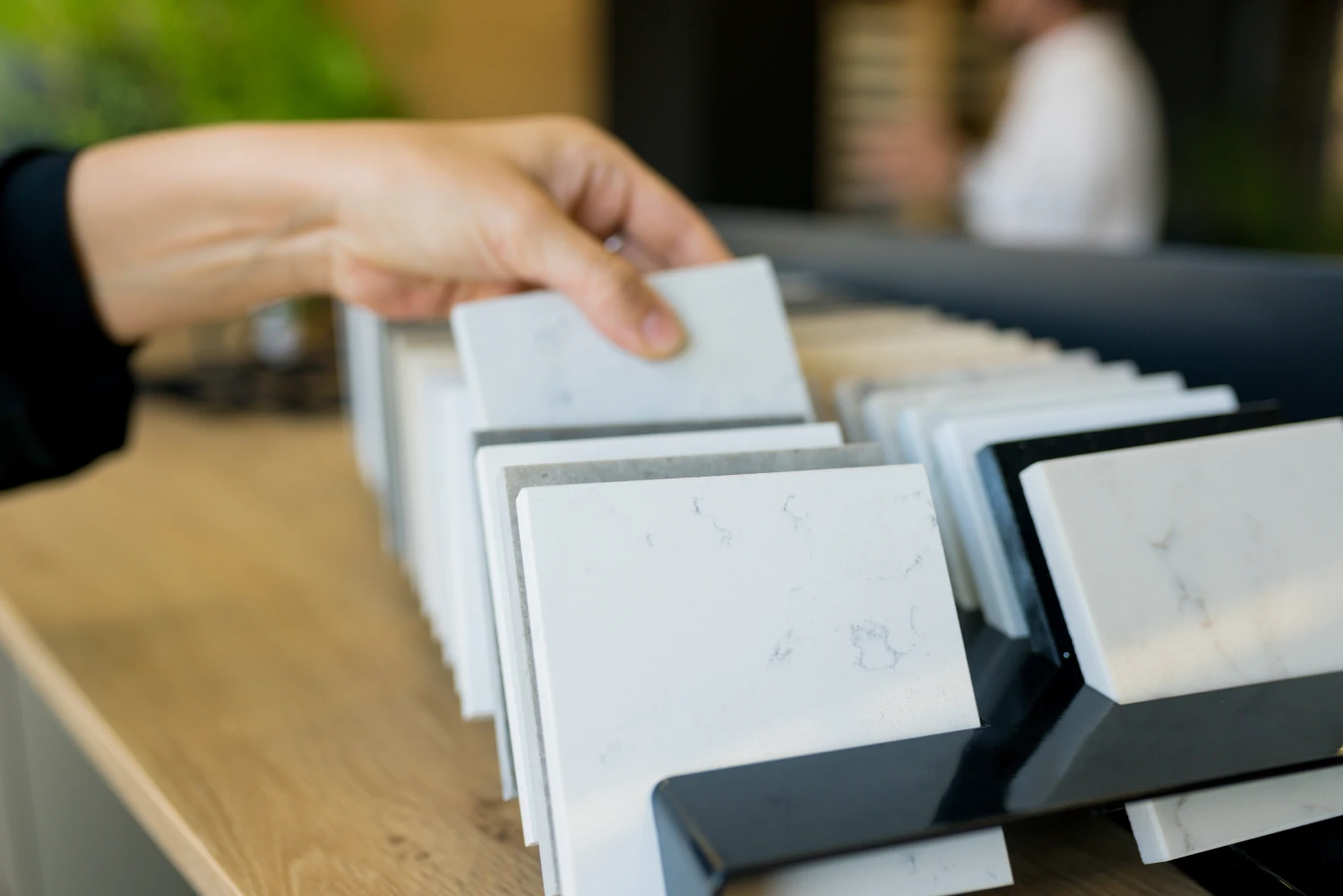
Key Points
- Quartz is usually the easiest-care choice for busy kitchens, but it still needs trivets and cutting boards because it is not heat-proof.
- Granite offers natural variation, strong everyday performance, and a classic look. Sealing requirements depend on the specific stone.
- Marble delivers distinctive natural veining, but it is more vulnerable to etching and staining. Countertop cost depends on far more than the material name alone.
Choosing a kitchen countertop is not just a question of which surface looks best in a showroom. You are choosing how your kitchen will perform through morning coffee, family dinners, holiday cooking, spills, cleanup, and years of everyday use. The right answer in the granite vs. quartz vs. marble countertops comparison depends on your priorities, your tolerance for maintenance, and the shape of your kitchen.
This guide explains the practical differences, the trade-offs homeowners often discover too late, and the details that actually drive countertop cost. It is written for homeowners planning a kitchen remodel in Bucks, Montgomery, or Lehigh County, where material selection is only one part of a larger design and construction decision.
1. The short answer: choose the surface that fits your habits
If you want a consistent appearance and simple daily care, quartz is often the most practical starting point. If you want the one-of-a-kind movement of natural stone and are comfortable following care guidance, granite can be an excellent fit. If the character of natural veining matters more to you than a perfectly unchanged surface, marble may be worth the added attention.
None of these materials is automatically “best.” A family that cooks heavily and wants low maintenance may make a different choice from a homeowner who sees the countertop as a design statement and accepts natural patina. A good design-build firm should help you make that trade-off before you order a slab, not after installation.
2. Quartz countertops: consistent design and low daily maintenance
Quartz countertops are engineered surfaces made with natural quartz particles, pigments, and binding materials. Because the pattern is manufactured, quartz can provide a more predictable color and veining pattern than natural stone. That consistency is valuable when you want a calm, coordinated look across an island, perimeter counters, and backsplash.
Quartz is also a popular choice for homeowners who want a low-maintenance surface. It does not require the same routine sealing conversation as many natural stones, and its nonporous surface is convenient for everyday cleanup. However, low maintenance does not mean indestructible.
Quartz is heat resistant, not heat proof. Manufacturer guidance recommends using trivets or hot pads and avoiding direct contact with very hot cookware. Use a cutting board rather than cutting directly on the counter, and clean spills with a soft cloth and an appropriate mild cleaner. Product care can vary, so the instructions for the selected brand should always control.
Quartz is a strong fit if you:
- Want consistent color and a broad range of contemporary or marble-inspired styles.
- Prefer simple daily cleaning and minimal routine maintenance.
- Are willing to use trivets, cutting boards, and manufacturer-approved cleaners.
The trade-off: Quartz can look highly consistent, but some homeowners prefer the depth and variation that only a natural slab provides. It can also be vulnerable to damage from excessive heat or improper cleaners.
3. Granite countertops: natural variation with strong everyday performance
Granite is a natural igneous stone, so every slab has its own mineral pattern, movement, and color variation. That individuality can make a kitchen feel more architectural and less predictable. It is especially effective when the countertop is intended to be a major visual feature rather than a neutral background.
Granite is known for strong resistance to everyday wear, including heat and scratching. Still, “durable” does not mean “ignore it.” The stone’s composition and finish influence whether an impregnating sealer is recommended and how often it should be renewed. Sealing improves stain resistance, but it does not make granite stain-proof.
The most important granite decision often happens at the slab yard or showroom. A small sample cannot show how a large island will look once the slab is cut. Ask to view the full slab and discuss where the fabricator expects to place seams, veins, sink cutouts, and the most prominent areas of movement.
Granite is a strong fit if you:
- Want a genuinely natural surface with one-of-a-kind variation.
- Place a high value on heat resistance and long-term everyday durability.
- Are comfortable with the possibility of periodic sealing and stone-specific care.
The trade-off: Natural variation is part of granite’s appeal, but it also means the installed countertop may differ from the sample you first liked. More dramatic movement may require additional design coordination around seams and cabinetry.
4. Marble countertops: exceptional character with a visible patina
Marble is a natural, calcium-carbonate-based stone prized for its soft movement, luminous background, and distinctive veining. It can bring a sense of history and craftsmanship to a kitchen that manufactured materials cannot fully duplicate.
The honest warning is that marble changes with use. Acidic foods and cleaners can etch calcareous stone, leaving a dull or lightly marked area even when no color stain remains. Citrus, vinegar, wine, and some acidic cleaning products deserve particular care. Marble can also be more susceptible to scratching and staining than granite, depending on the variety and finish.
For some homeowners, those marks are not a failure. They are part of a natural patina that makes the surface feel lived-in. For others, a countertop that may show evidence of cooking is a continuing source of frustration. That preference should be discussed early, because no installation detail can remove the basic characteristics of the stone.
Marble is a strong fit if you:
- Want natural veining and a refined, timeless focal point.
- Accept that etching and patina may develop over time.
- Are prepared to use cutting boards, coasters, trivets, and non-acidic cleaners.
The trade-off: Marble offers a design experience that is difficult to replicate, but it is not the easiest choice for a homeowner who expects the surface to remain visually unchanged.
5. Granite vs. quartz vs. marble countertops: side-by-side comparison
| Decision factor | Quartz | Granite | Marble |
|---|---|---|---|
| Appearance | Consistent colors and repeatable patterns | One-of-a-kind mineral movement | Distinctive veining and soft natural depth |
| Daily maintenance | Generally simple; follow brand care instructions | Clean regularly; sealing may be recommended | Requires more care around acids, stains, and scratches |
| Heat | Use trivets; not heat-proof | Generally strong heat performance, but trivets are still wise | Use trivets and follow stone-specific guidance |
| Stains and spills | Low-maintenance surface, but clean spills promptly | Sealing can improve stain resistance, not eliminate risk | More vulnerable depending on stone and finish |
| Best for | Busy kitchens that favor predictable design | Natural variation and durable everyday use | Homeowners who value patina and expressive veining |
| Main compromise | Can be damaged by excessive heat or harsh products | Slab variation and possible sealing needs | Etching, staining, and visible wear may occur |
6. What actually determines countertop cost?
Searching for “countertop cost” by material alone can create a false sense of precision. Two kitchens using the same quartz or granite can have very different totals because the fabrication and installation requirements are different.
The main cost drivers include:
- Square footage and perimeter length. A larger kitchen uses more material, but linear edge length also affects fabrication and finishing.
- Slab selection and availability. Premium colors, rare natural slabs, book-matched layouts, and higher-grade patterns can increase material cost.
- Thickness and edge profile. A standard eased edge is different from a built-up, ogee, mitered, or waterfall detail. Decorative edges require additional fabrication.
- Sink, faucet, and cooktop cutouts. Each opening must be measured and coordinated with the selected fixtures and appliances.
- Seams and layout complexity. Islands, corners, narrow passages, and prominent veining can make placement more complicated. Seam location matters for both appearance and performance.
- Removal and disposal. Existing countertops may need to be removed before the new surface can be templated and installed.
- Backsplash and end splashes. A short backsplash, full-height slab backsplash, or matching side splash can materially change the amount of material and labor involved.
- Cabinet and support conditions. Countertops require a sound, level base. Cabinet changes, reinforcement, plumbing adjustments, or layout changes can affect the overall remodeling scope.
A transparent proposal should identify these components instead of presenting one unexplained allowance. The published cost guide from The Home Depot also separates material, edges, removal, cutouts, sink work, plumbing, and backsplash considerations, which is a useful reminder that the “countertop” line often includes several distinct tasks. Local pricing and the final design still need to be confirmed through an in-home measure and project-specific proposal.
7. A practical selection checklist for your kitchen remodel
Before choosing a slab, answer these questions:
- Do you cook daily, entertain often, or use the island for homework and other activities?
- How important is resistance to heat, scratches, stains, or visible etching?
- Would you enjoy natural variation, or would a consistent pattern make design decisions easier?
- Are you willing to use trivets, cutting boards, coasters, and stone-safe cleaners?
- Where will seams fall, and how will the pattern run across the island?
- Does the countertop need to coordinate with existing cabinets, flooring, appliances, or a backsplash?
- Are the sink, faucet, and cooktop selections final enough for accurate cutout planning?
- Does the proposal clearly list material, fabrication, installation, removal, plumbing, backsplash, and edge details?
If you are comparing slabs, view the full piece whenever possible. Bring cabinet, flooring, and paint samples, and review the stone under lighting that resembles the kitchen. This is where design guidance can prevent an expensive mismatch.
8. How Aslan Design & Build helps you make the decision
Aslan Design & Build approaches kitchen remodeling as a design-and-construction process, not a standalone material purchase. The team serves homeowners throughout Bucks, Montgomery, and Lehigh counties and offers kitchen remodeling and kitchen design services.
The process begins with a consultation and an in-home visit to discuss goals, budget expectations, measurements, and how the space is used. During design, the team develops concepts, coordinates materials and fixtures, and refines the plan before preparing a detailed construction proposal. Aslan also describes transparent pricing, weekly project updates through its JobTread portal, and one point of contact through the work.
That structure matters when a countertop decision affects cabinetry, plumbing, appliances, lighting, and backsplash design. The goal is not to push one material. It is to help you choose a surface that fits the way you live and the level of care you are willing to provide.
A Montgomery County townhouse illustrates why material selection needs context
Maria C.’s experience offers a useful lesson for homeowners remodeling an established townhouse. Her six-year-old Montgomery County home had not been upgraded before she purchased it, so the project was not simply a matter of replacing one finish. As she describes it, Aslan spent time understanding her interests and the way her artwork, furniture, fabrics, kitchen, and window treatments needed to work together across the entire first floor.
That same thinking should guide a countertop decision. A marble-look quartz may be attractive on its own, but it still needs to relate to the cabinetry, flooring, backsplash, natural light, artwork, and furnishings already shaping the room. Likewise, a heavily patterned granite slab may be beautiful in a showroom but compete with a home that already has strong visual elements. The best surface is the one that supports the complete composition of the kitchen and the way the homeowner wants the room to feel.
Maria specifically praised Jeff’s eye for color and fabric, which is a reminder that material expertise is broader than knowing the difference between quartz, granite, and marble. It includes helping homeowners compare samples in context, anticipate how a large slab will read at scale, and make decisions that feel intentional across connected spaces. Her testimonial is not a promise that every project will have the same result, but it demonstrates the value of a consultation that starts with the homeowner’s interests instead of starting with a product catalog.
Conclusion: the best countertop is the one you can live with confidently
Quartz, granite, and marble can all create a beautiful kitchen. Quartz usually prioritizes easy daily care, granite balances natural character with strong performance, and marble delivers distinctive beauty with more visible maintenance and patina. Countertop cost becomes clearer when the proposal accounts for the full scope, including fabrication, cutouts, edges, seams, removal, and backsplash work.
If you are planning a kitchen remodel in Bucks, Montgomery, or Lehigh County, request a consultation with Aslan Design & Build. An in-home conversation can help connect your material preference to your layout, budget expectations, and long-term goals before the slab is ordered.
Frequently Asked Questions
Is quartz better than granite for a busy kitchen?
Quartz is often easier to maintain because it generally does not require the same routine sealing discussion as many natural stones. Granite offers strong everyday performance and natural variation, but the appropriate care depends on the specific slab. Neither should be treated as heat-proof, and both benefit from trivets and cutting boards.
Is marble a bad choice for kitchen countertops?
Not necessarily. Marble is a good choice for homeowners who value natural veining and accept that etching, scratches, and patina may develop. If you want a surface that stays visually uniform with minimal maintenance, quartz may be a more comfortable choice.
What is included in countertop cost?
Countertop cost can include the slab, measurement and templating, fabrication, edge treatment, seams, sink and appliance cutouts, installation, removal and disposal, plumbing adjustments, and backsplash work. Ask for each item to be identified in the proposal so you can compare options accurately.